Who Fought U.S. Forces in Iraq?
Casualties, Armed Factions, and the Historical Narrative Beyond September 30
With the coalition mission scheduled to end on September 30, 2026, a dispute over twenty-three years of history has returned to the fore: who fought U.S. forces, where were their losses concentrated, and who now holds the authority to decide questions of war and peace? Any answer must begin with casualty records and the geography of those losses, followed by the trajectories of the factions that fought, splintered, and declined.
The U.S. Department of Defense recorded 4,492 military deaths in Operation Iraqi Freedom and Operation New Dawn through the end of 2011: 3,519 attributable to hostile action and 973 to other causes. It also recorded 32,292 personnel wounded in action. Britain registered 179 deaths in Operation TELIC, including 136 attributable to hostile action. The U.S. record includes deaths outside Iraq arising from attacks that occurred inside Iraq, within the designated operational theater. [1][2][3]
The largest concentration of losses occurred during the early occupation years, with Baghdad, Anbar, and governorates in central and northern Iraq prominent in their geographical distribution. A U.S. assessment in 2005 described the core of the armed insurgency at that time as Sunni Arab. Meanwhile, the Mahdi Army and other Shia factions also fought U.S. forces, and additional groups and splinter formations subsequently emerged. These facts establish the diversity of participants and the variation in their roles over time. They do not confer on any faction active today an exclusive claim to the history of that war. [6][9][10]
Baghdad and Anbar at the Center of Coalition Losses: Who Carried Out the Attacks?
In the geographical distribution of the coalition fatality database, Baghdad ranks first with 1,433 deaths, followed by Anbar with 1,347, Salah al-Din with 436, Nineveh with 288, and Diyala with 266. Together, these five governorates account for 3,770 of 4,902 deaths, or 76.9 percent of a record compiled through 2020. The denominator, however, includes deaths after 2011, both combat and non-combat causes, and 332 deaths with no specified location. Baghdad also contained a dense concentration of headquarters, bases, and transport routes and was a demographically mixed city. Anbar, a geographically extensive and predominantly Sunni governorate, saw substantial troop
movements during and after the occupation because of its position along supply routes from neighboring countries. [4]
A U.S. document issued in March 2005 offers more direct evidence of the composition of the early armed insurgency. Drawing on intelligence and military officials, the Government Accountability Office (GAO) reported that approximately 80 percent of attacks at the time occurred in predominantly Sunni central Iraq. It also described the core of the armed groups as Sunni Arabs, encompassing tribal and Islamist factions alongside Baathists and members of the former regime.
This was a contemporary assessment of the 2003–2005 period, addressing the distribution of recorded attacks and the composition of armed groups. It does not mean that “80 percent of coalition fatalities were inflicted by Sunni factions.” The concentration of coalition losses in Baghdad, particularly its surrounding belt, and in Anbar, Salah al-Din, and Nineveh identifies the geographical distribution of those losses. It does not, by itself, establish who carried out the attacks. [6]
Geography requires greater precision than a governorate label can provide. Predominantly Sunni Arab Anbar was a major arena of armed resistance, as were parts of Salah al-Din. Nineveh and Diyala, by contrast, are diverse governorates. Sunni Arab factions were prominent in Mosul and in particular districts and rural areas, alongside other actors, while the balance of control shifted over time. In Baghdad, Sunni factions operated in parts of the city’s west and north and in its surrounding belt, while Sadr City and other neighborhoods witnessed military activity by Shia groups. Neither Baghdad nor Diyala can be reduced to a single communal identity. [6][36]
South of Baghdad, the term “Triangle of Death” became associated with Mahmudiyah, Yusufiyah, Latifiyah, Iskandariyah, and their surroundings, where armed groups intensified attacks on U.S. forces, Iraqis, and transit routes. This area included localities with a substantial Sunni Arab population. The term was neither an administrative designation for a governorate nor a sectarian classification of every village. The area also witnessed sectarian attacks. A U.S. Army historical study describes the role of these towns in the insurgency while documenting attacks on villages and towns justified on sectarian and other grounds. [40]
Basra, meanwhile, cannot properly be situated within a map of Sunni resistance. It is a predominantly Shia southern governorate that lay within the British deployment sector. British Ministry of Defence records document deaths in attacks in the city in 2007, while the Iraq Inquiry identified armed elements of the Mahdi Army as one of the principal threats to British forces in the south. Basra also experienced conflicts among Shia factions and between those factions and state institutions. Including deaths in Basra in the coalition total is therefore valid; attributing them to Sunni factions on the basis of a governorate ranking reverses the historical evidence. [41][42]
The groups operating across these environments represented different political and ideological orientations. They included nationalist and Islamist formations, such as the Islamic Army in Iraq and the 1920 Revolution Brigades, alongside networks associated with the former regime and al-Qaeda in Iraq. Various actors fought the occupation forces, but some also attacked the new Iraqi state. Al-Qaeda conducted extensive attacks on civilians and sought to inflame sectarian conflict. Fighters and tribes from some of the same early resistance areas later turned against al-Qaeda through the Awakening movement. No single label adequately captures the history of all these groups or their impact on Iraqis. [7][8]
The Mahdi Army, for its part, confronted U.S. forces in Najaf and Sadr City in 2004, with large-scale fighting recurring in 2008. Shia Special Groups also carried out attacks in subsequent periods, particularly as the withdrawal approached. The GAO reported repeated attacks by extremist Shia groups during that period and noted that fifteen U.S. service members were killed in June 2011, the highest monthly toll in two years. These events establish Shia participation in fighting U.S. forces. They do not justify attributing the entirety of the 2003–2011 losses to the factions that dominate today’s political and armed landscape. [9][10]
The limits of inference are therefore clear. Coalition losses were concentrated temporally and geographically in the early resistance years, and the 2005 document described the core of the armed groups in that period as Sunni Arab. Yet the fatality record contains no field identifying the faction responsible. Ranking factions by the number of U.S. personnel they killed would require incident-by-incident analysis, comparing claims of responsibility with investigations and supporting evidence. It cannot be accomplished by assigning a governorate’s fatalities to its population or to its best-known factions.
When Troops Patrolled the Streets: The Years of Greatest Attrition
The invasion began on March 20, 2003, and Baghdad fell on April 9. The Iraqi army and other formations fought during that phase, before most of the later resistance factions had emerged. From summer 2003, attacks on U.S. forces escalated in Anbar, Salah al-Din, and the Baghdad belt before spreading to other parts of central and northern Iraq. These areas were predominantly Sunni Arab, although fighting also occurred in Baghdad’s mixed neighborhoods. U.S. documents identify Fallujah, Ramadi, Samarra, Tikrit, and Baghdad as major theaters of confrontation. By the time of the Mahdi Army’s battles in 2004, fighting in those areas was already well established. This chronology does not identify the perpetrator of the first attack. [6][35][36]
The new governing arrangements help explain the divergence in political and military trajectories. The two principal Kurdish parties cooperated with Washington, and the Peshmerga fought alongside U.S. special operations forces in the north. Shia opposition parties, notably the Supreme Islamic Council and the Dawa Party, also entered the political process after the regime’s collapse, rather than making armed confrontation with U.S. forces their primary course of action. These were decisions by parties and leaders, not expressions of the position of every Kurd or Shia Iraqi toward the occupation. [37][38][43]
Many Sunni Arabs, by contrast, lost positions within the former state without acquiring an inclusive framework of representation in the initial post-invasion arrangements. The dissolution of the army and de-Baathification coincided with the conduct of occupation forces in their cities. Opposition to occupation thus intersected with lost influence and local grievances. This does not mean that every Sunni was a resistance fighter or that every resistance fighter was a Baathist. Within the Shia political landscape itself, the Sadrist movement departed from the course followed by parties participating in the Governing Council and subsequently fought U.S. forces in 2004. [7][39]
Following the invasion, foreign forces deployed across cities, roads, and bases, while armed groups multiplied and pursued different objectives. Over time, confrontation with U.S. forces became entangled with struggles over the state and sectarian violence that killed large numbers of Iraqis.
The published historical series of coalition fatalities records 4,800 deaths from all causes between 2003 and 2011. Of these, 4,216, or 87.8 percent, occurred in the five years from 2003 to 2007. The annual toll peaked at 960 in 2007, following 906 in 2004, 897 in 2005, and 873 in 2006. It then fell to 318 in 2008 and 146 in 2009, followed by 62 in 2010 and 58 in 2011. This series covers all nationalities and causes of death. It therefore differs from the U.S. Department of Defense count and must not be presented as the number killed in attacks. [4]
No single factor adequately explains this decline. In August 2007, U.S. troop strength reached approximately 169,000, compared with around 131,500 at the end of 2006. Deployment subsequently declined. The trajectory of losses reflected a combination of the troop surge, the Awakening movement, tactical changes, improvements in some force-protection measures, and shifts in local fronts. As troop numbers and exposed patrols decreased, fewer personnel were vulnerable to the types of attacks that had produced the losses of the early years. An annual casualty chart therefore describes changes in losses; it cannot independently measure the “intensity of resistance” without data on force levels, patrol activity, and the number and types of attacks. [5]
Sunni Arab Resistance Factions: Early Strength and the Fragmentation of a Common Front
Armed resistance in predominantly Sunni Arab areas was never a single organization. Nor did all groups fighting U.S. forces share a vision of how Iraq should be governed afterward. Some emerged from networks of former officers and soldiers and from Sunni Arab tribes in Anbar, the Baghdad belt, Salah al-Din, Diyala, and Nineveh. Iraqi Islamist formations and hardline al-Qaeda networks operated alongside them. Fallujah, Ramadi, al-Qaim, and Haditha, together with Abu Ghraib, Tarmiyah, Samarra, Tikrit, and Mosul, were prominent arenas at different points in the conflict. A faction’s presence in a governorate does not establish that it controlled the entire governorate or was responsible for every attack there. [6][7][19]
Major Sunni Arab Resistance Factions and Their Trajectories
| Faction or current | Principal areas and character of activity during the peak years | Subsequent trajectory |
|---|---|---|
| Islamic Army in Iraq | One of the most prominent Iraqi organizations in statements claiming attacks, active in Baghdad and its belt, Anbar, Salah al-Din, and Diyala. It encompassed local networks employing Islamist and nationalist rhetoric. | Entered into conflicts with al-Qaeda. Operations declined with the Awakening movement, local settlements, and the contraction of the U.S. presence. Its name persisted in political discourse more clearly than as a unified field force whose strength could be measured. |
| 1920 Revolution Brigades | Networks with tribal and religious connections in central and western Iraq, particularly the Baghdad belt and Anbar. Its units differed in their approaches to al-Qaeda and U.S. forces. | Hamas Iraq split from it in 2007, while parts of the same social milieu moved toward the Awakening movement. The historical organization did not persist as a unified fighting force. |
| Mujahideen Army, Rashideen Army, and Islamic Front for the Iraqi Resistance (JAMI) | Distinct local and Islamist formations operating in central and northern Iraq. Some sought coordination or a shared media platform. | Experienced fragmentation, the erosion of local support, and the incorporation of individuals into local arrangements. They cannot properly be combined into a single “Sunni army.” |
| Ansar al-Sunna / Ansar al-Islam | An armed Salafi current active particularly in northern and central Iraq, with changes in names and alliances. Its program differed from that of nationalist groups. | Its structures changed. Open sources do not establish the continuity of its former strength or its present membership. |
| Al-Qaeda in Iraq, subsequently the Islamic State of Iraq | A hardline jihadist network that fought U.S. forces but also targeted civilians and other Iraqis, inflamed sectarian violence, and fought tribes and armed factions from the same Sunni community. | Its record must not be subsumed within that of nationalist factions. Its organizational trajectory later extended to ISIS, the enemy confronted by the Iraqi state and a new coalition from 2014. |
| Naqshbandi and former Baathist networks | Prominent in parts of Salah al-Din, Nineveh, Kirkuk, and Diyala, becoming more visible after 2007 and during the 2014 crisis. | Fragmented and changed their relationships as state authority collapsed in some areas and ISIS rose. There is no evidence of a single chain of command continuing through 2026. |
No verified count has been published of the fighters in each of these factions in 2004 or 2007. Temporary alliances and overlapping membership increase the risk of double counting. Estimates of tens of thousands of Awakening members at their peak refer to a force that turned against al-Qaeda with U.S. support. They are neither a count of fighters in the factions listed above nor a measure of coalition fatalities attributable to them. Without a clear definition of who qualifies as a fighter and in which year, an apparently precise number becomes misleading. [20]
Three major turning points reshaped the landscape: the two battles of Fallujah in 2004; sectarian fighting in 2006–2007, which redirected some armed activity into internal warfare; and the Awakening movement from 2006–2007, which separated tribes and fighters from al-Qaeda. The 2011 withdrawal then removed the military target around which some formations had organized. The disappearance of an organizational name does not mean that its members disappeared. Some entered state institutions or politics; others were killed or detained; and some participated in subsequent cycles of violence. Distinguishing among these trajectories is essential to avoid attributing the crimes of ISIS to everyone who had previously fought the occupation. [8][19][20]
Shia Factions and Their Trajectories
The Mahdi Army entered the conflict as a broad Sadrist mobilization in Baghdad’s neighborhoods, particularly Sadr City, and in Najaf and Kufa, later extending to southern cities. Major battles in 2004 were followed by ceasefires and negotiations, before renewed fighting in Basra and Sadr City in 2008. A RAND study estimated that its strength may have reached 60,000 fighters by mid-2006. This is an approximate historical estimate of mobilization at a particular peak, not a precise personnel roster or a count of today’s Peace Brigades. Nor were all its units subject to the same degree of operational control or in agreement about attacking U.S. forces. [7][9][21]
Estimates of these groups’ strength require the same attention to historical context. The estimate of 60,000 Mahdi Army fighters in 2006, personnel figures for Popular Mobilization Forces brigades, and estimates of tens of thousands within allied factions in 2026 refer to different periods and definitions: registered personnel, active fighters, or mobilization networks. No detailed, verified current census is available that would permit a like-for-like comparison between each faction and its historical counterpart.
Religious Positions on the Occupation: Calls to Fight and Restraint in Najaf
During the early occupation years, the Association of Muslim Scholars in Iraq publicly rejected the U.S. presence and supported resistance. In November 2004, the Board of Trustees of the International Union of Muslim Scholars declared that those capable of doing so were obliged to fight occupation armies. The call for armed confrontation was explicit, although the union’s ruling came after resistance operations had begun. [28][29][30][31]
The senior religious authority in Najaf, by contrast, issued no equivalent call to fight U.S. forces. In April 2003, the London-based al-Khoei Foundation stated that Ali al-Sistani had called on Iraqis not to obstruct invading forces and to cease fighting in and around Najaf. His office, however, announced that the authenticity of the ruling attributed to him had not been established. The purported ruling against resistance remained disputed by his office, while a call for armed resistance was absent from its publicly stated position. The office subsequently emphasized opposition to rule imposed by the occupation authority, de-escalation, and the prevention of bloodshed on both sides. The Shia religious authority Muhammad Hussein Fadlallah, meanwhile, supported both peaceful and armed resistance. [25][32][33][34]
On the ground, the Sadrist movement was the principal broad-based Shia force fighting U.S. troops outside the trajectory of parties that entered government. The Mahdi Army fought major battles in 2004, and confrontations continued in subsequent years. Muqtada al-Sadr announced a suspension of its activities in August 2007. That suspension did not prevent renewed fighting during Operation Charge of the Knights in March 2008 and the subsequent battles in Baghdad. The position of the religious authority, the choices of parties participating in government, and the Sadrists’ armed trajectory thus diverged. They cannot be collapsed into a single Shia position.
From the 2003 Occupation to the 2014 Coalition: A Different Enemy and Mission
The 2011 withdrawal ended the phase of occupation and large-scale ground deployment. In 2014, an international coalition returned at Baghdad’s request after ISIS seized extensive territory, with a mission to help Iraqi forces defeat the organization. The role, deployment, and adversary of U.S. forces were different. An adviser or a service member operating from a fortified base did not face the same degree of exposure as a soldier on ground patrol in 2005 or 2007.
As of September 18, 2026, the U.S. Department of Defense had recorded 123 deaths in Operation Inherent Resolve: 25 attributable to hostile action and 98 to non-hostile causes. The operation’s geographical scope, however, includes Iraq, Syria, and other countries. All 123 deaths therefore cannot be plotted on a map of Iraq or added to the 2003–2011 toll as a homogeneous continuation of the same series. [11]
Regional escalation in 2026 produced another set of figures that should not be conflated with the invasion-era record. In July, the U.S. Department of Defense stated that Iran-aligned groups had carried out more than 600 attacks on U.S. citizens and facilities in Iraq between February and April. This is an attack count under the definition used in the U.S. statement, not a count of 600 direct hits or 600 fatal attacks. The regional Operation Epic Fury recorded fourteen deaths and 418 wounded personnel as of September 23, including seven deaths attributable to hostile action. These figures do not establish that all casualties occurred in Iraq or that Iraqi groups were responsible for all of them. A Reuters report on September 29 referred to seven U.S. deaths in Iraq during the regional war. Differences in operational scope, cause, and location preclude combining these figures into a single total labeled “coalition losses in Iraq.” [12][13][14]
The gap between reported attack frequency and the death toll reflects changes in warfare itself: fortified positions, drones and missiles, attacks conducted at a distance, a smaller deployment, and a regional conflict whose objectives extend beyond the expulsion of a widely deployed occupation force. An attack causing few human casualties can still have substantial political or economic consequences. The number of claims of responsibility, however, cannot substitute for an assessment of the attacks’ outcomes.
The War’s Financial Cost: U.S. Expenditure and Iraqi Losses
The war also imposed costs absent from fatality records. A study by Brown University’s Costs of War project estimated U.S. costs associated with the Iraq War and the extension of operations into Syria at $2.893 trillion: $1.793 trillion in costs through 2023, plus an estimated $1.1 trillion in future veterans’ medical care and disability-compensation commitments through 2050. The first figure comprises $862 billion in Pentagon emergency and overseas operations appropriations; an estimated $406 billion increase in its war-related base budget; $62 billion for the State Department; $230 billion in financing interest; and $233 billion in medical care and disability compensation through fiscal year 2021. Rounding individual components to the nearest billion may mean that their sum does not exactly match the stated total.
For Iraq specifically, the Congressional Research Service recorded $815 billion in related appropriations through the end of fiscal year 2014. During the counter-ISIS phase, the Iraq Train and Equip Fund received allocations of $241.95 million in 2024 and $380.76 million in 2025, alongside a request for $212.52 million for 2026. This fund is only one component of expenditure, and the 2026 request is not actual spending. Its amounts must therefore neither be combined with Brown’s estimate nor presented as a comprehensive total for Iraq through 2026. [15]
Any account confined to foreign military losses omits the Iraqi toll. Iraq Body Count has documented tens of thousands of violent civilian deaths during the occupation, civil war, and subsequent war against ISIS. Estimates of indirect deaths and displacement vary by methodology. Sectarian violence, forced displacement, and killings based on identity formed part of Iraqis’ experience in the same governorates where foreign forces came under attack. Opposition to the invasion does not turn the killing of civilians into “resistance.” Equally, the crimes of al-Qaeda and other organizations do not erase the fact that other factions fought occupation forces. [16]
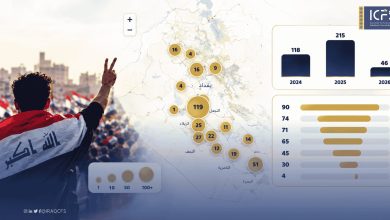
To illustrate the scale of the military presence associated with these costs, the accompanying chart presents the countries that deployed troops to Iraq and the size of their contributions. In May 2007, approximately 145,000 U.S. personnel were deployed alongside 12,600 personnel from twenty-five other countries. The country ranking shows each country’s highest documented deployment in different years, rather than the number of troops present simultaneously.
After Withdrawal: Who Holds Authority over the Use of Arms?
Baghdad announced the evacuation of coalition advisers from bases and command headquarters in federal areas in January 2026, while coordination concerning ISIS in Syria continued into the next phase. It designated September 30 as the date for ending the coalition’s military mission, amid discussion of a subsequent bilateral security partnership. The end of the mission does not automatically terminate training or intelligence cooperation. It does, however, alter the framework within which any operation against U.S. personnel must be understood. [17][18]
An attack after that date would not occur in the circumstances of 2003, when large foreign forces occupied roads and cities and multiple groups fought the occupation. It would occur in a country whose government declares the mission ended and demands that arms be brought under its exclusive authority, amid a regional war in which any strike launched from Iraqi territory carries implications for sovereignty and for financial, diplomatic, and investment relations. This does not predetermine the character of every subsequent U.S. presence or activity. Rather, it makes the nature of the target, the authorization for its presence, and the identity of the actor that ordered the attack indispensable questions before the act is politically characterized.
An accurate historical account consequently grants no contemporary faction exclusive ownership of the war years. It shows that the greatest concentration of losses occurred in a period, in places, and among actors substantially different from those shaping Iraq in 2026. It also establishes that Shia groups fought U.S. forces at particular stages. Beyond September 30, Iraq’s test is whether it can determine the terms of its own security relationships and prevent its territory from being used to initiate a war its institutions have not authorized.
Sources and Documents
- Defense Casualty Analysis System (DCAS), Operation Iraqi Freedom, casualty category table; September 2026 update.
- Defense Casualty Analysis System (DCAS), Operation New Dawn, casualty category table.
- UK Ministry of Defence, fatalities in Operation TELIC.
- iCasualties, coalition fatality database; annual and geographical distributions from a historical extract through 2020.
- U.S. Government Accountability Office (GAO), reporting on Iraq and U.S. troop deployment, 2006–2007.
- U.S. Government Accountability Office, GAO-05-431T, March 2005.
- RAND, Counterinsurgency in Iraq (2003–2006).
- Combating Terrorism Center at West Point, study of the Islamic Army in Iraq.
- RAND, The 2008 Battle of Sadr City.
- U.S. Government Accountability Office, GAO-11-774, 2011.
- Defense Casualty Analysis System, Operation Inherent Resolve; September 18, 2026 update.
- U.S. Department of Defense, record of the July 14, 2026 meeting with the Iraqi prime minister.
- Defense Casualty Analysis System, Operation Epic Fury; September 23, 2026 update.
- Reuters, September 29, 2026 report on the departure of U.S. forces and U.S. fatalities in Iraq during the regional war.
- Brown University, Costs of War project, estimate of the costs of the Iraq and Syria wars, 2003–2023.
- Iraq Body Count, database of documented civilian deaths.
- Iraqi Higher Military Commission tasked with ending the coalition mission, January 2026 statement.
- Iraqi–U.S. joint statement on the transition, September 2024, and U.S. reaffirmation in July 2026.
- Combating Terrorism Center at West Point, study of Iraqi armed factions and their symbols, March 2008.
- U.S. Government Accountability Office, reporting on changes in attacks in 2007–2008; RAND studies of the Awakening movement and the insurgency.
- RAND, Counterinsurgency in Iraq (2003–2006), estimate of Mahdi Army strength in mid-2006.
- U.S. Department of State, statement designating Asaib Ahl al-Haq, 2020; the attack count is a claim by the issuing authority.
- U.S. Department of State, statement designating Kataib Hezbollah, 2009; and Country Reports on Terrorism 2023.
- U.S. Government Accountability Office, GAO-06-953T, discussion of the major militias.
- Office of Grand Ayatollah Ali al-Sistani, response to a question concerning security disturbances, April 2004.
- Office of Grand Ayatollah Ali al-Sistani, sermons of June 13 and June 20, 2014.
- Office of Grand Ayatollah Ali al-Sistani, sermon of July 4, 2014, on organizing volunteers and restricting arms to state authority.
- Association of Muslim Scholars in Iraq, official archive materials on the association’s identity and establishment after the invasion.
- Association of Muslim Scholars in Iraq, Statement No. 29, April 5, 2004; and Harith al-Dhari’s message on the occasion of the 2011 withdrawal.
- Board of Trustees of the International Union of Muslim Scholars, statement on the obligation to resist occupation armies in Iraq, November 2004.
- Yusuf al-Qaradawi, statement denying the attribution to him of a ruling permitting the killing of U.S. civilians, official website, 2004.
- Muhammad Hussein Fadlallah, press interview on peaceful and armed resistance in Iraq, 2004, official website archive.
- Office of Grand Ayatollah Ali al-Sistani, responses concerning the November 15, 2003 agreement and the legitimacy of occupation authority.
- Office of Grand Ayatollah Ali al-Sistani, denial of the attribution to him of a ruling against resisting the invasion, April 2003; and response concerning security disturbances, April 2004.
- U.S. Government Accountability Office, GAO-04-902R, documentation of deteriorating security from June 2003 and the events of April 2004.
- U.S. Government Accountability Office, GAO-06-1094T, discussion of cities affected by fighting in central and northern Iraq.
- U.S. Government Accountability Office, GAO-04-746R, cited for the establishment of the Iraqi Governing Council and the representation of Kurdish and Shia political forces.
- RAND, After Saddam: Prewar Planning and the Occupation of Iraq; and the Iraq Inquiry’s volume on preparations for post-Saddam Iraq, concerning opposition parties.
- RAND studies of the Sadrist movement, its position outside the initial political arrangements, and the confrontations of 2003–2004.
- U.S. Army Center of Military History, Surging South of Baghdad, concerning Mahmudiyah, Yusufiyah, Latifiyah, and Iskandariyah.
- UK Ministry of Defence, fatality notifications relating to attacks in Basra in April and June 2007.
- The Iraq Inquiry, Volume VIII, assessment of the threat from armed Mahdi Army elements in Basra, 2006–2007.
- U.S. Army Center of Military History, To Baghdad and Beyond: ARSOF in Operation Iraqi Freedom, documentation of U.S. special operations forces and Peshmerga operations on the northern front in 2003.