Iraq’s Difficult Choices: Domestic Dynamics amid External Shifts
Executive Summary
The confrontation between Iran and Israel is escalating into a more open and dangerous phase, opening the door to difficult scenarios: continuation of the war under current balances, Iran’s retreat and Israeli dominance, collapse of the Iranian regime, or Iran’s ascendancy and the decline of Western influence. Each scenario imposes distinct trajectories on the Iraqi scene. The Iraqi government faces growing pressure to balance between Washington and Tehran, while armed factions within the “Axis of Resistance” may become more active. At the same time, Iraq’s internal political forces will reposition themselves with each unfolding scenario, making the country highly sensitive to regional shifts. Regionally, Turkey, Saudi Arabia, and the Gulf states closely monitor the changing balance of power to safeguard their geopolitical interests, while the United States and Israel engage in military and diplomatic efforts to contain Iranian influence. These scenarios reflect an open-ended trajectory of escalation, placing Iraq before difficult choices: neutrality, alignment, or slipping into the confrontation itself.
Regional Conflict and the Nature of Transformations
The declared war between Iran and Israel represents one of the most unprecedented escalatory phases in the regional conflict in the Middle East. For much of the recent period, this conflict has taken the form of proxy wars, limited aerial and cyber strikes, intelligence operations, and targeting of interests. Both parties mobilized every possible political and economic tool, drawing on international and regional alignments. They exploited the geography of the wider Middle East as a battlefield that extended beyond their own borders and drew in several states—with Iraq at the forefront. The current stage of direct and sustained confrontation marks a different level of conflict, heightening risks for Iraq, which remains a strategically important but vulnerable arena for both sides.
The Military Nature of the War
Within days of continuous escalation, the region witnessed intense exchanges of strikes across multiple fronts, employing diverse tactics and weaponry:
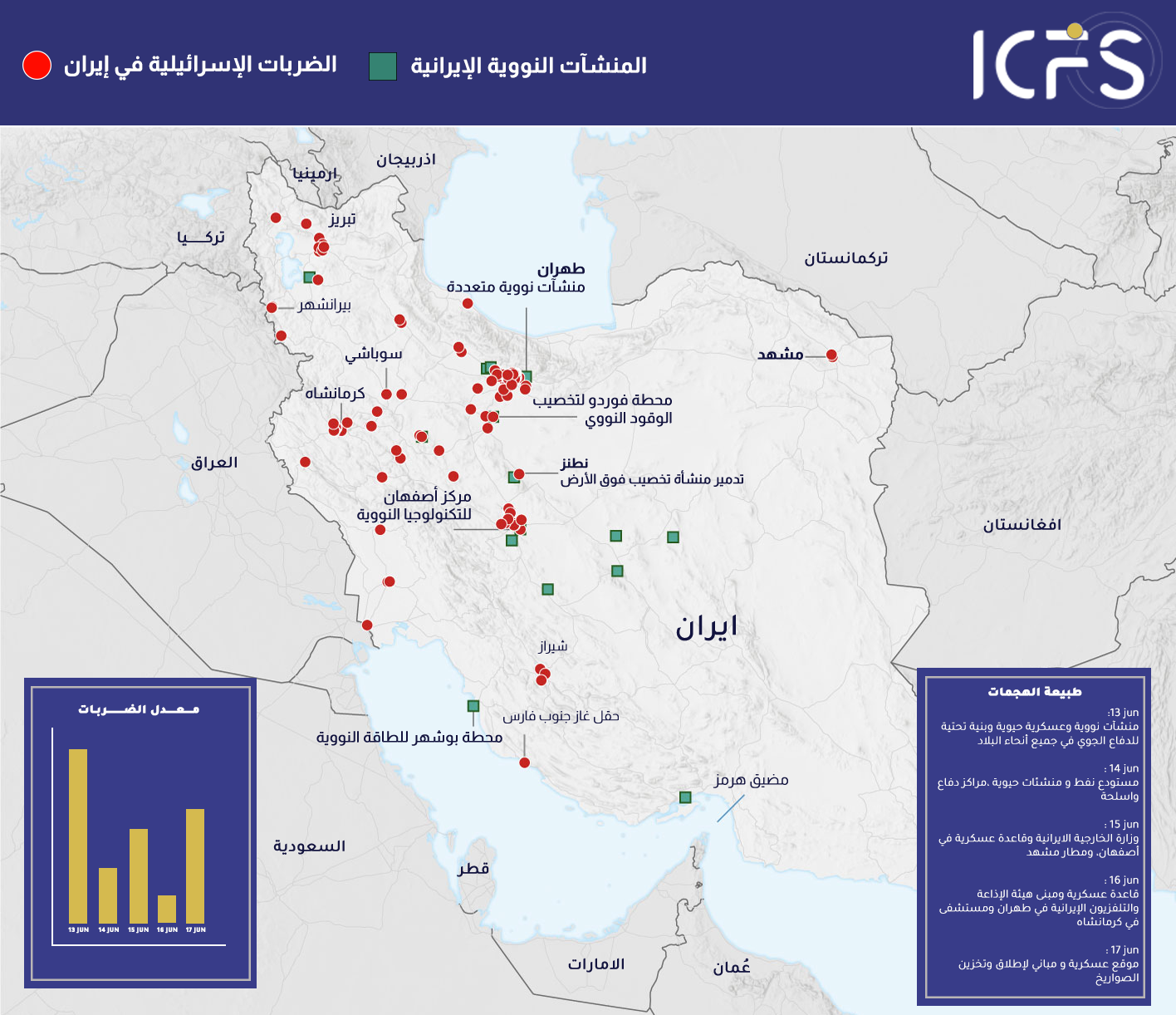
Israel carried out precise, sequential airstrikes, including more than 280 raids deep inside Iran, targeting military and strategic facilities (nuclear sites, missile launch points, command centers). Israel capitalized on its advanced technological and military edge—deploying F-35 and F-15 fighter jets in coordination with Mossad intelligence, supported by internally launched drones. The strikes targeted Islamic Revolutionary Guard Corps bases, nuclear scientists, and senior security leaders, including members of the top command echelon and their designated successors. These precision strikes inside Iranian territory were concentrated on dismantling the military-nuclear infrastructure.
Geographic Scope
The strikes focused on multiple key sites across Iran’s geography, most notably Tehran, Natanz, Isfahan, and Kermanshah, as illustrated in Map (1)
Figure (1): Map
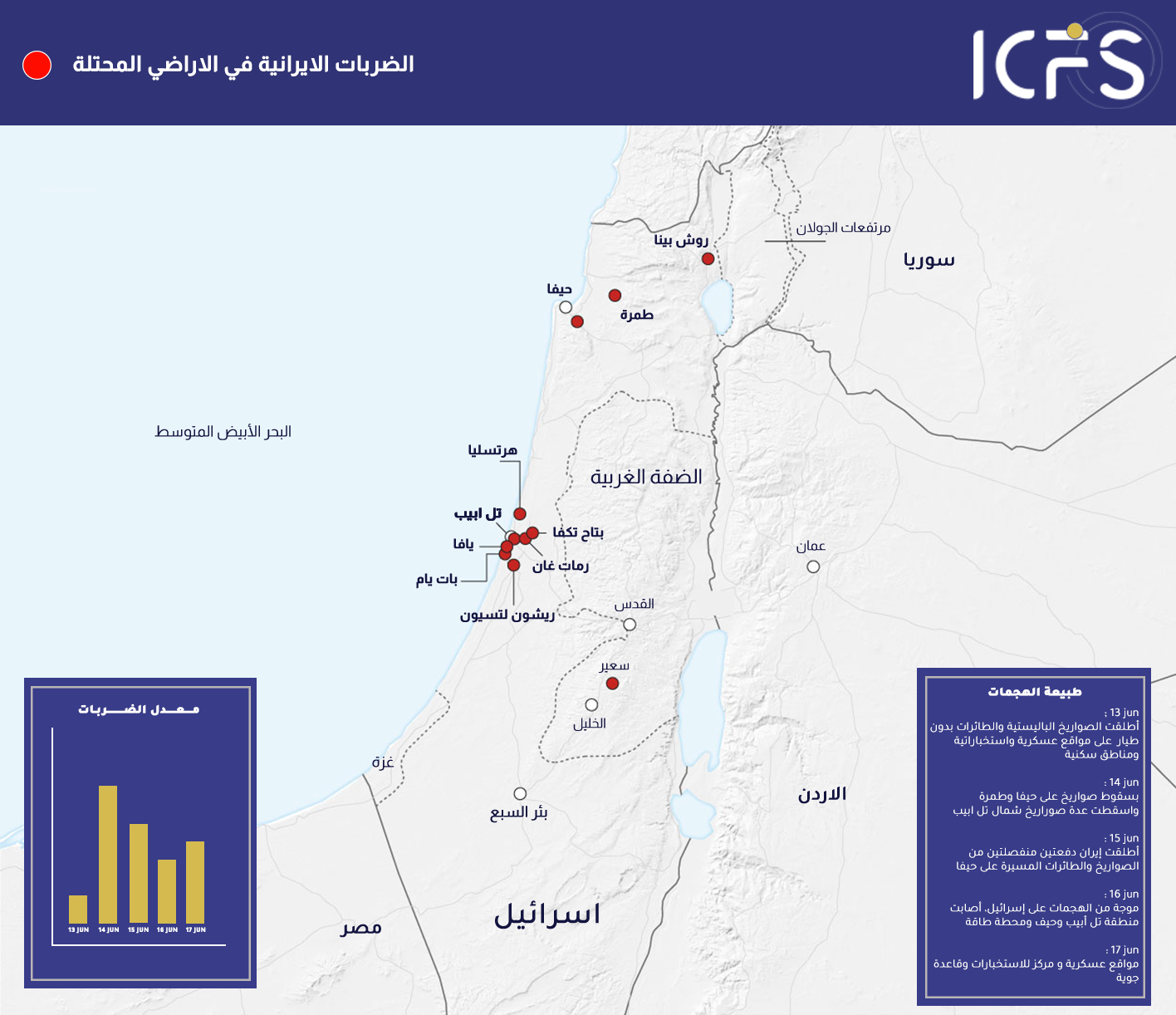
Iran responded by launching hundreds of ballistic missiles and drones in successive waves, successfully breaching the Iron Dome defense system and causing damage to strategic and vital facilities. Its response relied on a strategy of mass saturation, employing multi-directional barrages of missiles and drones. Several of these projectiles penetrated the Iron Dome, inflicting damage on strategic sites, including an oil refinery and a scientific institute.
Geographic Scope:
The strikes were concentrated on Tel Aviv, Haifa, as well as air bases and intelligence centers spread across Israel, as illustrated in Map (2)
Figure (2): Map
Possible Paths of the War
Scenario One: Continuation of the War under Current Balances (No Decisive Outcome)
This scenario assumes the absence of indicators pointing to an end of the war, in light of the diminishing will of influential international actors to intervene decisively—primarily the United States and Europe. These powers benefit from the pressure placed on the Iranian regime and seek to keep Iran weakened enough to accept negotiations under Western conditions, pushing it to concede further on its nuclear program. At the same time, this scenario supports Israel’s regional presence and sustains its image of victory domestically and regionally.
On the other hand, Iran’s allies such as Russia and China show limited commitment, shaped by their own strategic struggles with the United States and the West in other arenas, particularly Ukraine and Taiwan, as well as ongoing economic rivalries.
Regionally, Middle Eastern states prefer to prevent the conflict from spreading in ways that threaten their interests, even as they benefit from its prolongation short of outright chaos. However, they are equally vulnerable to the rise of either side, based on the geopolitical calculations of the region. These states strongly oppose any attacks on nuclear facilities, whether Iranian or Israeli, due to the immense risks posed to their security. This applies to countries such as Turkey, Saudi Arabia, Pakistan, and others.
Scenario Two: Weakening of Iran and Israeli Ascendancy (Regional Power Hierarchy)
This scenario could materialize under conditions of unlimited U.S. and Western support for Israel, while Iran prioritizes regime survival and makes concessions if it perceives: (a) credible willingness by Washington’s allies to decisively intervene, and (b) continued weakness of international allies’ engagement on its behalf. Painful measures may be taken to coerce Iran into this path, potentially producing a less hardline faction within Iran’s political leadership and prompting Tehran to recalibrate its influence in the Middle East to fit its reduced standing.
If Iran demonstrates resilience in absorbing the shock of losing top leaders—through Israel’s assassinations of senior officials, including even the Supreme Leader—this could either stabilize the regime under new leadership or push developments into Scenario Three, depending on the system’s response.
Scenario Three: Collapse of the Iranian Regime and Spread of Chaos
This scenario remains part of the threats wielded by Israel and the United States, particularly the prospect of assassinating the Supreme Leader. While still hypothetical, it could shift into action if both parties decide to escalate the war further than seen thus far. Tehran seeks to avoid this, as reflected in its current level of attacks and official rhetoric. Israel, however, has floated the option as part of its endgame considerations. Such an outcome would trigger transformative changes in the Middle East and beyond, potentially extending instability into East Asia.
This scenario depends on U.S. willingness to accept such drastic change, which does not appear to be an immediate priority. Washington continues to emphasize weakening Iran into negotiations rather than outright regime collapse. Moreover, such upheaval would invite international and regional interventions into a broader arena of chaos.
Regional powers are determined to prevent this scenario, but if it occurs, they will adapt pragmatically. Some, such as Turkey and Pakistan, may edge closer to confrontation with Israel, seeking to distract and contain it through expanded conflict zones that avoid endangering their own security. Others may align more tightly with Western powers, seeking protection and framing Israel as a security partner.
Scenario Four: Iranian Ascendancy and Preservation of Regional Influence, Israeli Retreat (Western Decline)
While Western support for Israel makes this scenario seem unlikely, it cannot be ruled out. If Western powers remain neutral—or if Iran and its allies somehow neutralize them despite the difficulty—Iran could recalibrate the conflict to its advantage. This would involve halting the war at a moment favorable to Tehran’s calculations, with Iranian deterrence capacity rising while Israeli strikes lose effectiveness under international constraints.
Iran could then leverage domestic Israeli fragility, demographic and morale challenges, and intensified qualitative strikes to create existential pressure on Israel. Meanwhile, it could synchronize diplomatic efforts with battlefield resilience, maximizing its position.
In this path, Iran might also exploit regional states’ pressure to end the war, aligning its national security with their interests at a suitable moment. This could lead to regional arrangements where Iran gains the symbolic victory over Israel while offering concessions to other regional powers—calculating to reclaim those concessions later. While highly uncertain and unlikely given Western resistance, this remains within the realm of possible scenarios.
Key Notes:
- The absence of internal de-escalation channels between the parties means solutions will likely come from international powers, depending on the seriousness of regional states’ pressure.
- Either party may adopt an extreme strategy aimed at total destruction of the other, escalating the conflict to its most radical form.
Iraq: Fragility at Home and Abroad
Iraq suffers from long-standing political and security fragility, with its stability depending on a precarious regional balance. It has become both a theater for Iranian influence and a target of Israeli strikes on that influence. Iraq is thus drawn into confrontation despite the state’s attempts to maintain balance through its relations with Washington and the West. Yet this balance remains fragile, shaped by conflicts beyond its borders and their direct repercussions on its domestic scene.
Iraq’s internal order is fragmented, with multiple actors tied in different ways to external powers, and these actors simultaneously shape state policy from within. While the state seeks to preserve national interests, various groups pursue cross-border agendas, creating contradictions that complicate Iraq’s positioning.
To assess how the war might affect Iraq, it is inaccurate to view “Iraq” as a unified actor represented solely by the state. Rather, one must identify the main domestic actors and situate them within the broader scenarios:
- The Government: Institutions and key figures managing a mix of domestic forces, attempting to preserve Iraq’s national interest by channeling or restraining other actors.
- Shiite Political Forces: The dominant political bloc, generally supportive of maintaining the Iranian system as a regional ally, though differing in degree of alignment with Tehran.
- Sunni Political Forces: Lacking cohesive ideological drivers, they prioritize access to power, adapting internal and external positions according to their private interests.
- Kurdish Political Forces: Oriented around Kurdish nationalist aspirations and party-specific interests. Internal divisions have eroded their collective project, though the current crisis could push them back toward coordination.
- Armed Factions: Varying in names and legal status, these groups are the closest to aligning fully with Iran, given their ideological orientation and belief in existential ties.
- The Sadrist Movement: A mass Shiite current with religious, political, security, and social dimensions. It positions itself as nationalist, while maintaining complex ties with Iran.
- The Religious Authority (Marja‘iyya): A religious institution with immense geo-religious and social influence, advocating a national line often in quiet competition with Iranian influence. Western actors perceive it more moderately than other Shiite authorities.
- The Street (Public Opinion): The largest demographic bloc but weakest in impact, fragmented across sectarian and social lines. It tends to support general nationalist positions but lacks organizational capacity and mobilization.
Iraq’s Interaction under Each Scenario
Impact of Scenario One on Iraq: Continuation of the War under Current Balances (No Decisive Outcome)
| Actor | Expected Reaction | Notes |
|---|---|---|
| Government | Continued management of balance between Tehran and Washington amid lack of clarity in foreign policy; leveraging higher oil prices | — |
| Armed Factions | Preservation of political and field influence; maintaining gains; support through political stance and securing the domestic front | Alignment in discourse and conviction of shared destiny, though with differing weight and influence |
| Shiite Political Forces | Preserving political and field gains; supporting Iran politically; adjusting rhetoric toward “Shiite nationalism”; seeking cross-sectarian alliances | — |
| Sunni Political Forces | Relative stability; pursuit of greater gains; exploiting pressure on Iran in rhetoric and electoral mobilization | — |
| Kurdish Forces | Efforts to reorganize internally; relative stability; pursuit of greater political leverage; leaning further toward regional allies | — |
| Sadrist Movement | Reinforcing its nationalist-Shiite discourse; winning popular support; maintaining “strategic latency”; intermittent activism and messaging | — |
| Najaf Marja‘iyya | Continued monitoring without direct involvement; pressuring political actors behind the scenes; stressing security risks | — |
| The Street | Increased political interest; relative shifts in political choices; rising discontent; continued fragmentation with the emergence of grassroots triggers | — |
Impact of Scenario Two on Iraq: Weakening of Iran and Israeli Ascendancy (Regional Power Hierarchy)
| Actor | Expected Reaction | Notes |
|---|---|---|
| Government | Seeking alignment with international direction; strengthening ties with the Gulf and the West; reducing reliance on Iran; empowering army and police | Decline of Iranian sway in state decision-making |
| Armed Factions | Erosion of ties; decline in influence in favor of political actors; strategic confusion; internal struggles over resources; factional splits | — |
| Shiite Political Forces | Decline of traditional actors; emergence of new forces; reconfiguration of alliances; shifting rhetoric toward nationalism; building cross-sectarian coalitions | — |
| Sunni Political Forces | Push for rebalancing; rise of new parties with revised discourse; ongoing fragmentation; greater leverage | — |
| Kurdish Forces | Renewed internal coordination; closer alignment with the West and Turkey; deeper involvement in central decision-making to strengthen autonomy | Sulaymaniyah may shift positively in relations with Turkey |
| Sadrist Movement | Advances as an alternative to Iranian influence; adopts nationalist discourse; competes for Shiite street and authority | — |
| Najaf Marja‘iyya | Expands role in religious discourse; guides societal actors; supports peaceful transition; mitigates intra-Shiite conflict | — |
| The Street | Resurgence of popular discontent; civic groups attempting to organize; rising rights-based discourse; growth of civil current amid ongoing fragmentation | — |
Impact of Scenario Three on Iraq: Collapse of the Iranian Regime and Regional Chaos
| Actor | Expected Reaction | Notes |
|---|---|---|
| Government | Crisis in control and border security; internal fragility; rising oil revenues; appeal for external support; empowerment of army and police | — |
| Armed Factions | Potential fragmentation; partial reintegration into state structures; shift toward politics; loss of control for some groups; leadership targeting; heavy sanctions | — |
| Shiite Political Forces | Decline and fragmentation of traditional actors; emergence of new forces; reconfiguration of alliances; shift toward nationalism | — |
| Sunni Political Forces | Formation of new alliances; external sponsorship; efforts to secure areas from chaos; security vacuums; resurgence of extremist groups | — |
| Kurdish Forces | Security arrangements to protect the region; expansion of security and political space; repositioning of Peshmerga; reliance on external partners | — |
| Sadrist Movement | Exploiting the chaos; revival of armed activism; clashes with pro-Iran groups; continued political participation | — |
| Najaf Marja‘iyya | Central role in maintaining balance; containing chaos within Shiite and national frameworks; larger role in regional Shiite organization; engaging diplomatically | — |
| The Street | Security fragility; strengthened tribal roles; social instability; risk of renewed violence | — |
Impact of Scenario Four on Iraq: Iranian Ascendancy and Preservation of Regional Influence, Israeli Retreat (Western Decline)
| Actor | Expected Reaction | Notes |
|---|---|---|
| Government | Leaning more toward Iran; bolstering Tehran-backed political forces; reduced Iraqi visibility regionally | — |
| Armed Factions | Enhanced political and military strength; deeper control of political system; expanded influence in Sunni and Kurdish arenas | — |
| Shiite Political Forces | Consolidation of power; increased involvement of military leaders in politics; stronger dominance over Sunnis and Kurds | — |
| Sunni Political Forces | Marginalized in decision-making; greater subordination to Shiite and Iranian forces; or alternatively, stronger alignment with Turkey and the Gulf | — |
| Kurdish Forces | Greater Shiite pressure; deeper divisions; heightened sense of vulnerability; attempts to secure ties with Tehran; stricter border security; deeper but unrewarding engagement in Baghdad | — |
| Sadrist Movement | Stronger resistance to Iranian dominance in rhetoric; positioning as an independent nationalist alternative; mobilizing protests as “political resistance” | — |
| Najaf Marja‘iyya | Increased caution; emphasis on distancing from escalation; insistence on religious independence from Wilayat al-Faqih | — |
| The Street | Growing public resentment; louder rejection of foreign-dominated politics | — |
Conclusion
For Iraq, the greatest challenge lies in managing this regional entanglement in ways that safeguard national interests, particularly amid diverging internal actors. Baghdad’s ability to avoid alignment with a single axis, while leveraging balanced neutrality, could allow it to redefine its regional role as a mediator rather than merely a battleground. Internal actors’ measured responses will be decisive in shaping outcomes.
Ultimately, Iraq’s options are not determined solely by regional complexity, but also by its own capacity to build a strategic response framework that enhances stability and reduces vulnerability in a moment of profound regional volatility.
Events are unlikely to follow a single linear scenario. Instead, the regional reality may unfold through overlapping trajectories: Iranian influence could recede in some arenas while holding or even expanding in others; Israel may achieve tactical gains without establishing decisive strategic dominance. This partial overlap keeps the horizon open to cross-cutting, nonlinear shifts, complicating efforts to predict the conflict’s ultimate direction.